

'Curing' brain diseases
Chemogenetics--really?

I’m attending an amazing meeting on Parkinson’s Disease sponsored by ASAP (Aligning Science Across Parkinson’s) and, of course, treatment/cure of PD is a yuuge theme. ‘A long time ago in a galaxy far, far away’ my lab invented DREADDs—the most widely used and, frankly, useful chemogenetic technology.
The technology itself was first reported in 2005 at the ACNP meeting and, of course, only 1 person was interested enough to stop by the poster!
When we were thinking about the utility of chemogenetics, our ‘big idea’ was to treat Parkinson’s Disease as it is well known which brain circuits we would need to turn on or turn off. There is an amazing paper published three years ago in Cell (how did I miss this) providing a convicing proof-of-concept in non-human primates and mice. Here is their conclusion:
“Application of this therapeutic approach (chemogenetics) rescues locomotion, tremor, and motor skill defects in both mouse and primate models of PD, supporting the feasibility of targeted circuit modulation tools for the treatment of PD in humans.”
And now, apparently, they are testing this in humans—I can hardly wait to see the results!
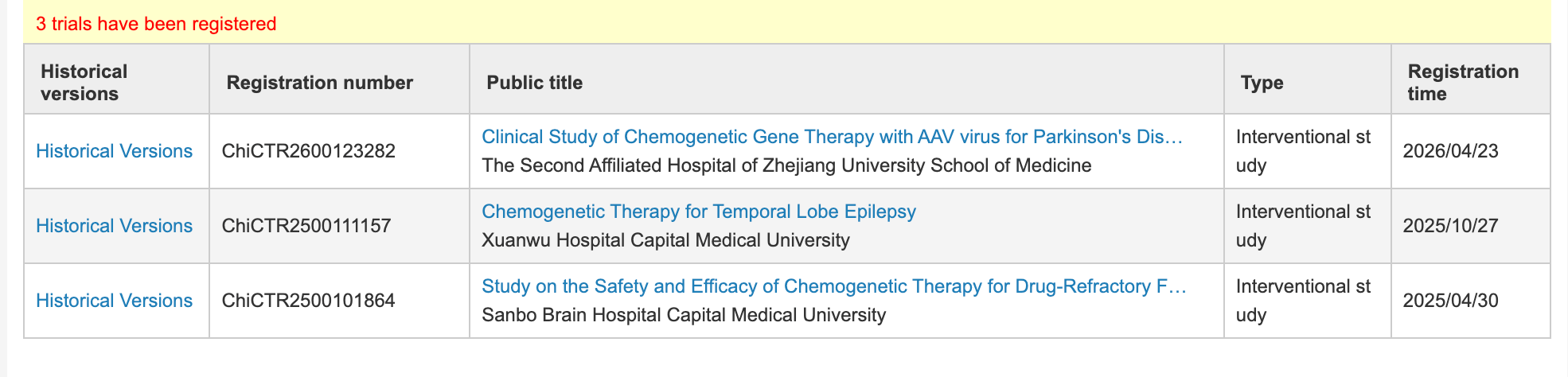
Assuming chemogenetics works in ANY of these trials, this clearly opens an approach to actually ‘cure’ brain diseases with circuit-based therapeutics. Or as someone once said:
“Imagine if no family had to feel helpless watching a loved one disappear behind the mask of Parkinson’s or struggle in the grip of epilepsy. Imagine if we could reverse traumatic brain injury or PTSD for our veterans who are coming home.” (Barak Obama’s remarks in 2013 on the Brain Initiative)
Well..that time is now!
Congratulations on seeing the technology reach human trials, that's a rare arc to live through.
A question your framing raises: the Cell result rescued locomotion, tremor, and motor skill in the models, which is restoration of function in circuits that are still there. Does the path to 'cure' you're imagining mean halting the underlying degeneration, or is circuit modulation more like a far more precise, programmable version of deep brain stimulation, controlling symptoms in surviving circuits?
Curious where you'd put chemogenetics on that line, since the answer probably shapes which of these trials counts as success.
Keep the hope coming. My wife's sister-in-law has Parkinsonism.