

Why you should consider being a CRO for the NIH: Part 1
Lower the National Debt by being more cost-effective!

My decades of zen training have alerted me to a “disturbance in the force” related to a recent exhortation regarding scientific excellence and the role of government in acclerating discoveries where they highlight the potential/real advantages of:
Targeted investments in teams devoted to a single scientific problem
Time-limited investments
Enhanced use of CROs, FROs and for-profit entities
There are real merits to this idea and this is the first of several substacks I’ll post over the next week or so
In the beginning:
In the late 1990’s I was a struggling Assistant Professor at CWRU’s Biochemistry and Psychiatry Departments. My work was generally considered ‘pedestrian’ as I published mainly in pharmacology (think JPET and Mol Pharm) and biochemistry (Biochemistry! JBC!) journals. One day the spokesperson for the MD/PhD program ask me:
“Bryan, why don’t you publish in journals I’ve heard of? What is this journal ‘Molecular Pharmacology’?”
A dear, and now departed, close friend Paul Ernsberger (discovered the Imidazoline Receptor) noticed a call for a contract entitled: NIMH Psychoactive Drug Screening Program. At the time I was (and still am) quite interested in antipsychotic drug actions and I had collected a large number of clones for GPCRs and other potential targets.
As my lab was struggling and the prospects of tenure were dim, I thought that if I could garner this yuuge contract (perhaps $800,000/year total costs) at least I could keep my lab running and the university would allow me stay around for a few more years. My chair at the time—kindly—said:
“OK Bryan, if you get this contract, I will find a bit more space for you and you can stay as long as you have NIH funding. When you lose your funding you will have to leave”
So….we applied. My understanding is that there were a total of 2 applications (a 50% chance) and that one was a for-profit entity. Here’s why we got (and have been able to renew) the contract:
We underbid, overpromise and over-deliver for-profit entities
The NIMH headed by Steve Hyman (a fellow psychiatrist) took a chance on us and we got the contract more or less as a trial. If/when we failed to meet our milestones they would go back to the CRO. I have many faults, but I rarely miss milestones and so, we (Estela, Xi-ping, Sandy, Wes, John and countless others over the years) have now been fortunate to have run this contract since 1998.
Here I will share my thoughts on the economic benefits to the US Government.
Why it is more cost-effective for the Government and Universities to consider contract research:
1. Our personnel costs are a fraction of the costs associated with CRO/FRO’s
Cost of an entry-level PhD scientist in my lab (includes fringe and overhead):
$73,000/year ($60K entry salary) + 55% overhead=$93,000
Cost of an entry-level PhD scientist at a CRO:
$110,000/year (low-end; range to $150,000/year depending upon location) + Modified Direct Costs of ~25%=$127,000 (lowest end) to ~$180,000/year
Our technical staff positions are filled with recent (mainly) UNC graduates and part-time UNC students who are paid at least 50% less than what they would get paid in a ‘real job at a real biotech company’
Most stay a year or so and then move on to professional or graduate schools or ‘real jobs’
Part-time workers do not receive benefits so costs are less
2. Our assay costs are a fraction of the costs associated with a CRO.
With contract negotiations, of course, one never knows the bid of the other potential entities, but we have looked into the economics of this in some detail:
We promise ~900,000 assays/year and, per the public record our total costs are: ~$ 3 million with a per-assay cost of ~$3/assay. One assay is defined by us as a single concentration tested in quadruplicate. So we are promising around 3.6 million wells/year
A typical CRO charges considerably more for a single GPCR functional assay. Here, one assay is defined as a single concentration in singleton. If you want duplicates the cost is double!
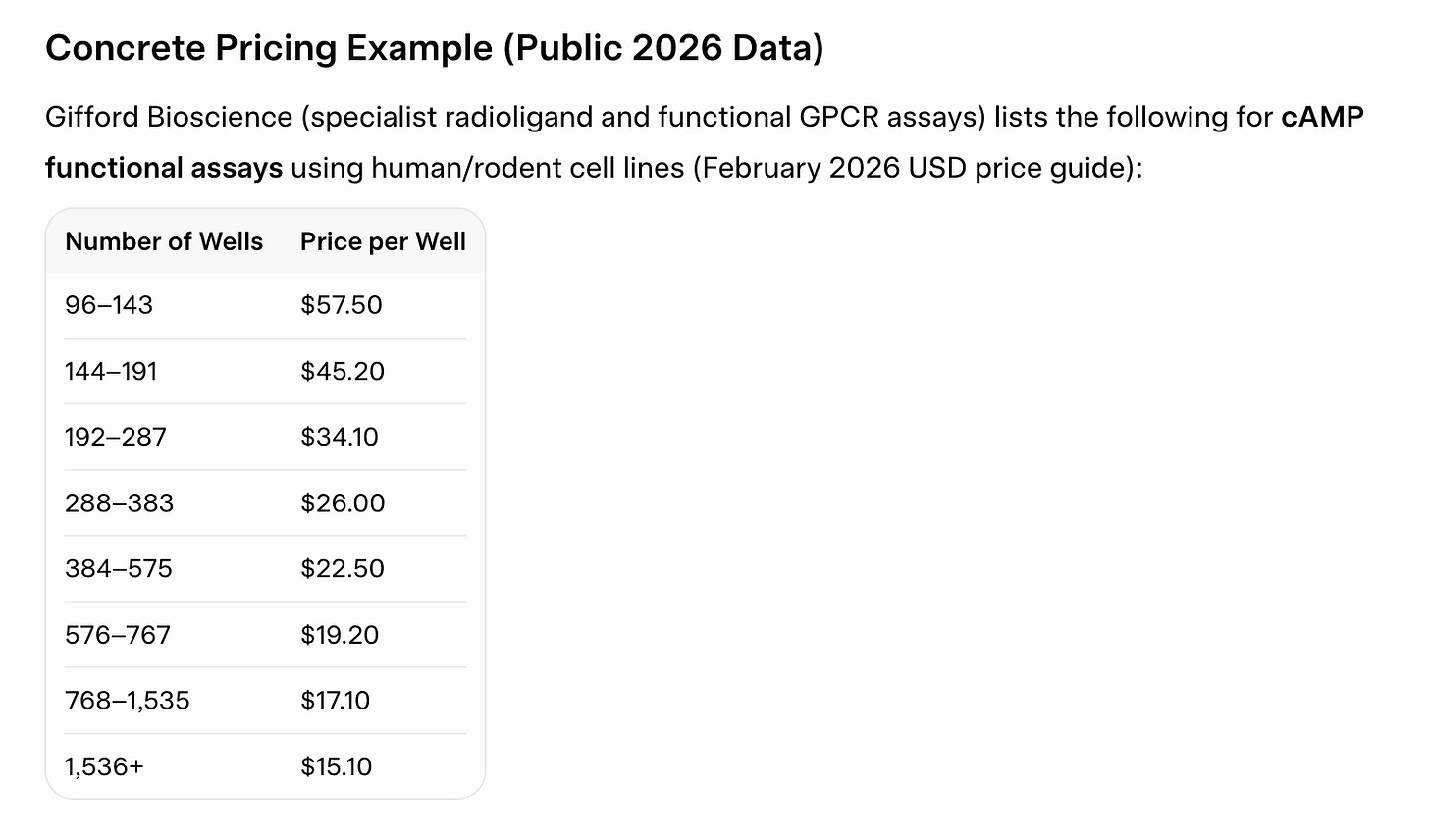
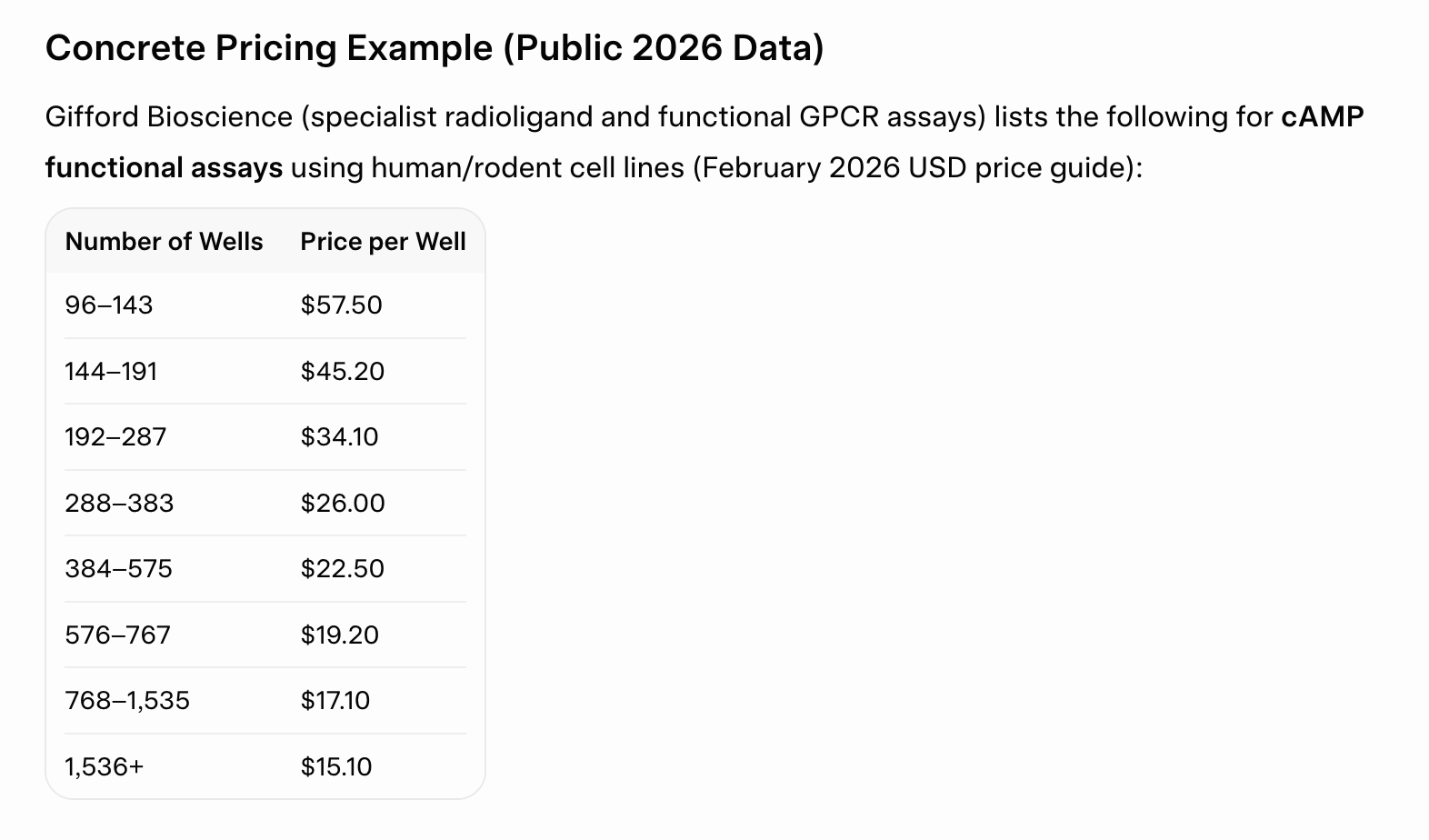
So even if you greatly discounted the per-assay cost for a single well there are the additional costs of generating data of sufficient quality (e.g. replicates) that they can be ‘trusted’. At any rate, assuming a CRO could lower their per-well costs to $5/well to provide a comparable service the costs would be:
$5 x 3 (triplicate) x 900,000=$13.5 million/year by CRO
vs
$3 million/year by UNC
3. If you want us to repeat the assay it is free; a CRO will charge you the same price for additional assays.
4. We provide free on-line databases of pharmacological data which are exceedingly useful and frequently visited (~200-300,000 visits/month)
5. I provide free and timely expert advice and also QC (along with XP) the assays.
6. We provide free and timely editing of the technical portions of your manuscripts that use data we provided without authorship credit (over the past 5 years more than 500 papers have cited support from the PDSP and we supported more than 500 investigating teams!)
There is more to this, of course, and based on the feedback I’ll expand on other themes over the couple of weeks.