

An amazingly disturbing dopamine paper
The extended ternary complex model explains why this can be easily predicted


I recently read an astounding new paper from the lab of Chris Ford on dopamine and dopamine signaling kinetics published in

Here they investigated what most of us naive biochemists would consider a ‘solved problem’: how dopamine signaling at the D2 receptor is modulated in space and time in vivo. Before I go further, however, I just need to point out that in the brain, Go is the main Gi-like protein (not Gi).
Of course, we know that D2 receptors (my lab solved the first D2 structure; and later many active-state structures) signal as shown below:
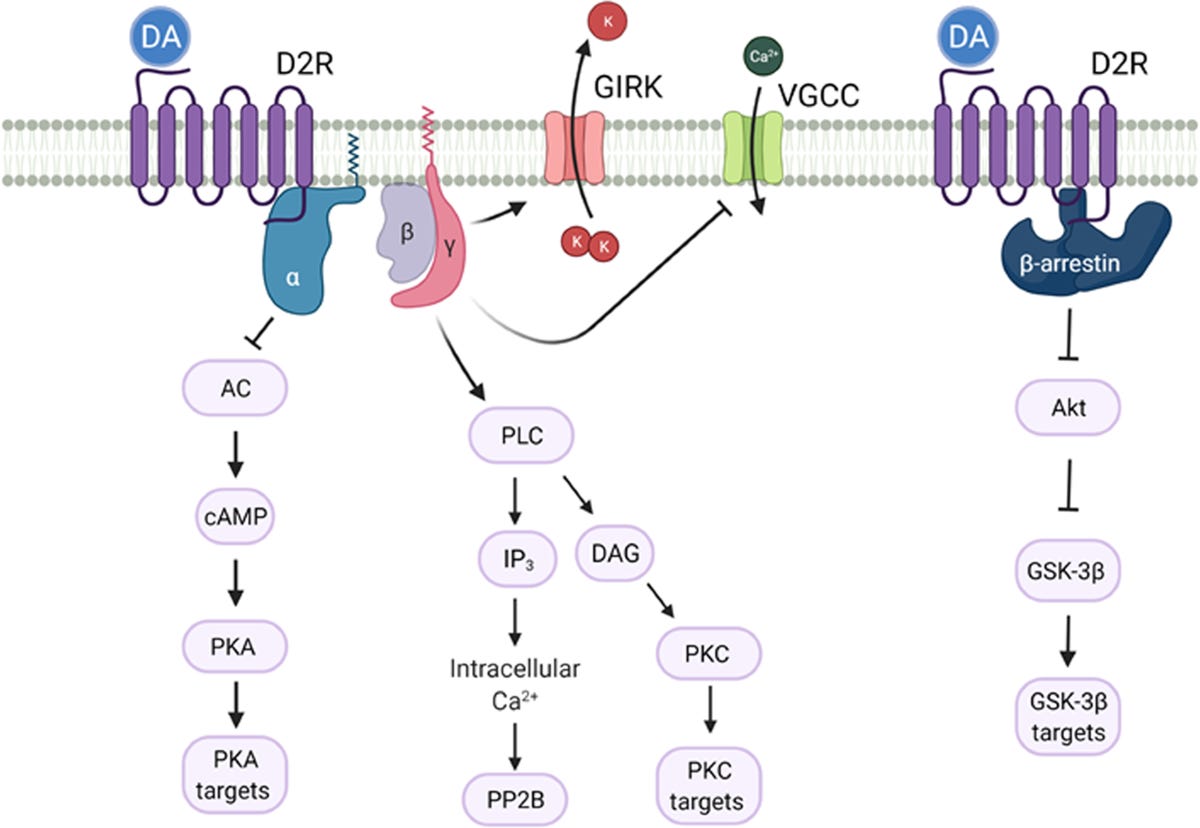
The Ford group, knowing the complexity encoded above, systematically investigated the potency and efficacy of extracellular dopamine for activating these various pathways with a focus on: inhibition of cAMP formation and activation of GIRK channels.
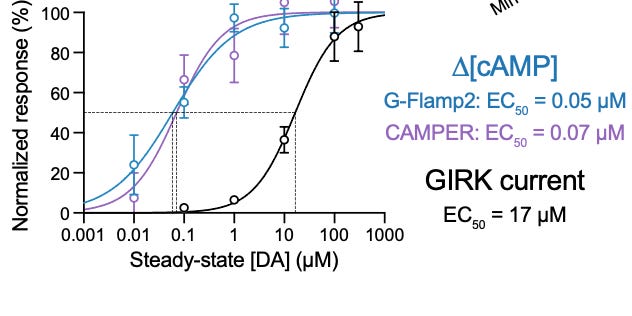
As you can see, the dose-response for the cAMP response was 50-70 nM while the GIRK current required 17 uM (300-times more DA!). The authors propose the following explanation:
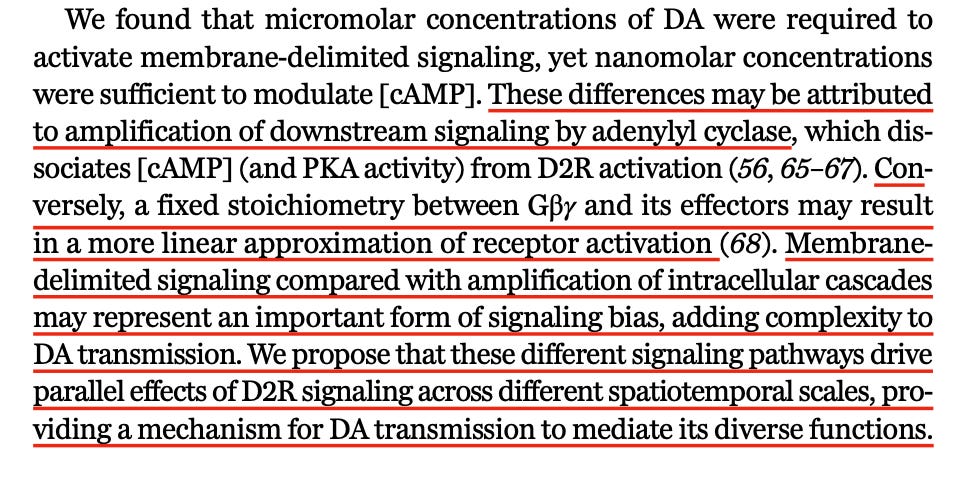
This may be true, but there is another interpretation from the Extended Ternary Complex Model.
Remember that the model predicts that receptor expression alone (or at least receptor expression in proximity to transducers) has a yuuuge effect on agonist potency and efficacy:
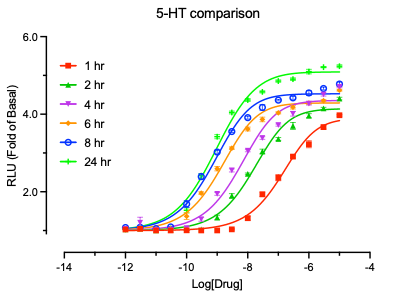
In fact, the results of the amazing Science paper can be explained solely by the following model:
Go-mediated inhibition of cAMP occurs in domains with relatively high receptor/Go expression (note according to ECM either Go or R can drive the dose-response to the left)
Go-mediated activation of GIRK channels occurs in cellular domains with relatively low receptor/Go expression
Of course this may have nothing at all to do with what they are measuring….
I note, however, that many years ago we reported a very similar phenomenon from in vitro biochemical experiments:
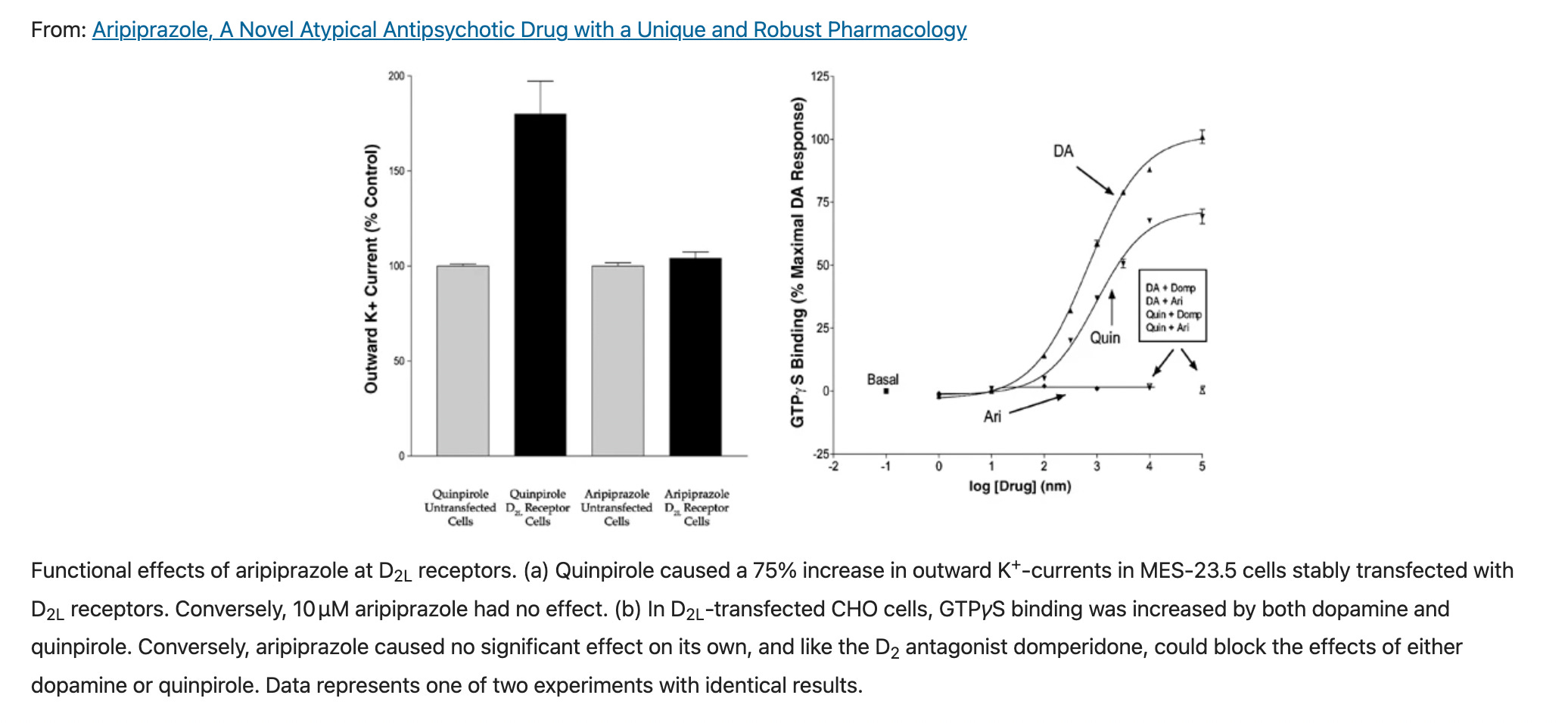
As can be seen, when cells which endogenously express GIRK channels with stably transfected with D2 receptors are evaluated for GTP-g-S binding (a proxy for receptor activation), DA has micro-Molar potency (uM). By contrast, DA is a nM potency inhibitor of cAMP formation (OPC-4392 is aripiprazole) in vitro:
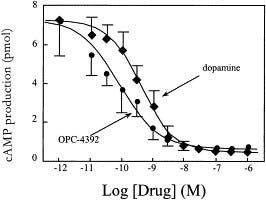
I don’t know if our results in vitro are due to differential R→G coupling (though I’m pretty sure that’s what’s going on) in localized microdomains…but stay tuned!!
How do you think the signaling would be affected past 24 hours with tetracycline? Do you think the signaling you would observe would be biologically relevant at say t = 72+ hr or later?